
For the 2026 school year, there are 6 public schools serving 2,244 students in Vermillion County, IN.
The top-ranked public schools in Vermillion County, IN are Central Elementary School, South Vermillion High School and Van Duyn Elementary School. Overall testing rank is based on a school's combined math and reading proficiency test score ranking.
Vermillion County, IN public schools have an average math proficiency score of 30% (versus the Indiana public school average of 39%), and reading proficiency score of 35% (versus the 41% statewide average). Schools in Vermillion County have an average ranking of 1/10, which is in the bottom 50% of Indiana public schools.
Minority enrollment is 6% of the student body (majority Hispanic), which is less than the Indiana public school average of 37% (majority Hispanic and Black).
Best Public Schools in Vermillion County (2026)
School
(Math and Reading Proficiency)
(Math and Reading Proficiency)
Location
Quick Facts
Rank: #11.
Central Elementary School
(Math: 55-59% | Reading: 35-39%)
Rank:
Rank:
7/
Top 50%10
208 S 9th St
Clinton, IN 47842
(765) 832-7731
Clinton, IN 47842
(765) 832-7731
Gr: PK-5 | 370 students Student-teacher ratio: 13:1 Minority enrollment: 7%
Rank: #22.
South Vermillion High School
(Math: 35-39% | Reading: 40-44%)
Rank:
Rank:
6/
Top 50%10
770 W Wildcat Dr
Clinton, IN 47842
(765) 832-3551
Clinton, IN 47842
(765) 832-3551
Gr: 9-12 | 468 students Student-teacher ratio: 10:1 Minority enrollment: 6%
Rank: #33.
Van Duyn Elementary School
(Math: 30-34% | Reading: 35-39%)
Rank:
Rank:
4/
Bottom 50%10
15095 S Range Line Rd
Clinton, IN 47842
(765) 832-7761
Clinton, IN 47842
(765) 832-7761
Gr: PK-5 | 257 students Student-teacher ratio: 14:1 Minority enrollment: 2%
Rank: #44.
North Vermillion Elementary School
(Math: 28% | Reading: 34%)
Rank:
Rank:
4/
Bottom 50%10
5585 N Falcon Dr
Cayuga, IN 47928
(765) 492-7010
Cayuga, IN 47928
(765) 492-7010
Gr: PK-6 | 313 students Student-teacher ratio: 10:1 Minority enrollment: 7%
Rank: #55.
South Vermillion Middle School
(Math: 25% | Reading: 31%)
Rank:
Rank:
3/
Bottom 50%10
950 W Wildcat Dr
Clinton, IN 47842
(765) 832-7727
Clinton, IN 47842
(765) 832-7727
Gr: 5-8 | 487 students Student-teacher ratio: 14:1 Minority enrollment: 5%
Rank: #66.
North Vermillion High School
(Math: 10-14% | Reading: 35-39%)
Rank:
Rank:
3/
Bottom 50%10
5555 N Falcon Dr
Cayuga, IN 47928
(765) 492-3364
Cayuga, IN 47928
(765) 492-3364
Gr: 7-12 | 349 students Student-teacher ratio: 10:1 Minority enrollment: 5%
Vermillion County Public Schools (Closed)
School
Location
Quick Facts
72 E 1100 S
Clinton, IN 47842
(765) 832-7718
Clinton, IN 47842
(765) 832-7718
Gr: PK-5 | 224 students Student-teacher ratio: 11:1 Minority enrollment: 5%
Frequently Asked Questions
What are the top-ranked public schools in Vermillion County, IN?
The top-ranked public schools in Vermillion County, IN include Central Elementary School, South Vermillion High School and Van Duyn Elementary School.
How many public schools are located in Vermillion County?
6 public schools are located in Vermillion County.
What is the racial composition of students in Vermillion County?
Vermillion County public schools minority enrollment is 6% of the student body (majority Hispanic), which is less than the Indiana public schools average of 37% (majority Hispanic and Black).
Which public schools in Vermillion County are often viewed compared to one another?
Popular comparisons of public schools in Vermillion County include: Van Duyn Elementary School vs. Central Elementary School, Central Elementary School vs. Van Duyn Elementary School, North Vermillion High School vs. South Vermillion High School
Recent Articles

Helping Children Overcome First-Week School Anxiety
Learn practical strategies to help children overcome first-week school anxiety, with expert-backed tips for parents and educators.
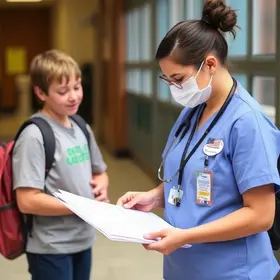
Public School Immunization Requirements 2026鈥�2027
Learn public school immunization and health requirements for 2026鈥�2027, including vaccines, exemptions, and state policy updates.

Public Schools in a Minute: 2026 Snapshot Guide
A clear 2026 snapshot of public schools in the U.S., including enrollment, funding, trends, and what families should know.